
The first request was a small one. An international energy group, already working with our team on its corporate intranet, asked for a Copilot session for its HR department. It was a small group of people who wanted to understand how the assistant could support their daily work.
That session opened a longer conversation. The group was preparing a Microsoft 365 Copilot pilot and needed a way to let people test the tool properly, so that management could judge its usefulness and the return on the investment. In roughly a year, the relationship grew into three consecutive programs: the HR session, the pilot and a company-wide rollout reaching colleagues in Europe, Mexico and the United States.
This is the story of how one program design, adapted to leaders, everyday users and individual departments, kept the same quality across continents and time zones.
The Problem: one pilot, many audiences, several time zones
In an international group, rolling out Copilot is less a licensing exercise than a coordination problem. Three issues shaped the project.
- The first program was explicitly a test. Licenses went to a pilot group, and the company needed clear signals before extending them, such as whether people found Copilot useful, whether they kept using it, whether the investment made sense. Generic training would not produce those signals. Participants had to see Copilot at work inside the applications they open every day.
- Executives and everyday users approach Copilot in different ways. Leaders want to understand where the assistant fits in their decisions and how to sponsor its use; employees want to know which prompt to write in Outlook or Excel the next morning. Departments such as Finance have their own processes and vocabulary. A single, uniform course would have left at least one of these groups behind.
- The audience grew beyond Europe when the company decided to extend licenses to the whole organization. Colleagues in Mexico and the United States work about nine hours behind their European counterparts, so one live session could never reach everyone. At the same time, the group wanted a consistent experience for all, with the same content, the same depth and the same chance to ask questions, wherever people were based.

Our solution: a three-level program delivered in three time slots
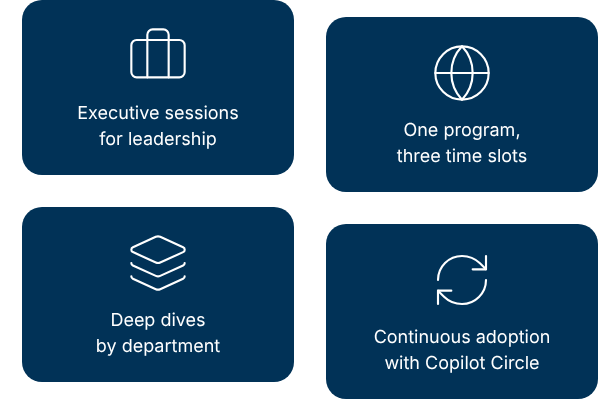
We designed one adoption program with three levels, then adapted its delivery to the shape of the organization.
The backbone was a core program of five live sessions covering an introduction to Copilot, Copilot Chat, and Copilot in Teams, Outlook, Excel, PowerPoint and Word, with related topics grouped in pairs. During the pilot, every session ran twice and the cycle closed with a dedicated Q&A, so participants could bring the questions that had come up while using Copilot on their own work.
In parallel, the leadership team followed executive-oriented sessions, also offered in two slots to fit busy agendas. When some leaders could not attend, we helped the internal sponsor prepare a lunch and learn to bring them up to speed. Visible commitment from the top made it easier to ask the rest of the organization to invest time in a new way of working.
After the pilot, the company extended Microsoft 365 Copilot licenses across the organization and asked our team to repeat the program on a larger scale. We kept the structure and changed the delivery:
- Longer sessions: each core session grew from one hour to an hour and a half, leaving room for deeper demonstrations and questions instead of covering two tools in sixty minutes.
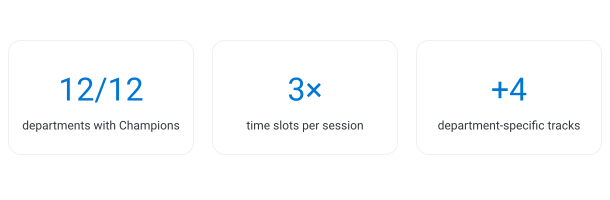
- Three slots for every session: two for European colleagues, one in the morning and one in the afternoon, plus one scheduled for the teams in Mexico and the United States, so nobody had to join in the middle of the night.
- Optional transversal sessions: two additional sessions, each run twice, for people who wanted to go further once the core program was complete.
- Department deep dives: targeted sessions for four departments, with Finance receiving two dedicated episodes.
The whole company-wide program runs over about four months, and our team fitted every session into the deadline the customer had set.
For the company-wide phase, the group activated Copilot Circle for its Microsoft 365 Copilot users. The Adoption Agent reads the usage data Microsoft already makes available, places each person in a maturity cohort, from Early adopter to Champion, and sends personalized nudges with use cases, ready-made prompts and short microlearning modules.
IT and HR follow progress on an adoption dashboard that breaks usage down by department, so they can see where Copilot has taken root and where people need more support. Only usage signals are analyzed, suc as which Copilot experience was used on which day: prompts and content are never read.

The Results: steady adoption and Champions in every department
The company-wide program is still running, yet the adoption dashboard already tells a clear story, and the customer's decisions along the way tell another.
- High, steady adoption: the adoption rate has stayed consistently high since licenses were extended to the whole company, including the periods when new users were being onboarded.
- A minimal share of inactive users: the Inactive cohort remains a very small part of the licensed population, so licenses are being used rather than left idle.
- Champions in all 12 departments: every department now counts at least one Champion, a frequent and broad Copilot user who can help colleagues find the next use case.
- A pilot that convinced management: participants' feedback on the pilot was consistently positive, and the sponsor asked to extend the program to the whole company shortly after it ended.
- Trust that spreads across the group: while the core program was still underway, the company asked us for a proposal for an associated company in the group.
In practice, three programs in roughly a year grew out of a single session for HR, each one built on what the previous one had shown.

What's next?
The remaining core and department sessions will complete the current program, while Copilot Circle keeps supporting users once the live training ends.
The next chapter is already being discussed, and it is about bringing the same model to another company in the group.
💡 A solid program design travels well, as long as its delivery adapts to the people who will use it.
Are your Copilot users spread across teams, countries or time zones? Book a demo and see how Copilot Circle keeps adoption consistent everywhere, combining live training with an AI agent that follows every user after the sessions end.