
.svg)
When a large multinational industrial group decides to invest in artificial intelligence, it is not a light decision. Internal expectations are high, processes are complex and the employees involved number in the thousands. Every misjudgement translates into measurable waste, both in economic terms and in terms of internal credibility for those who championed the change.
The company had purchased an initial batch of Microsoft 365 Copilot licences with a specific goal: to understand how the tool could genuinely integrate into everyday work, before deciding whether and how much to scale the investment. This was not a definitive rollout, but a considered pilot programme, managed by an internal digital transformation team with the responsibility of bringing concrete data and feedback to leadership.
The challenge was not technical. The Microsoft infrastructure was in order, the licences were available, IT was aligned. The real question was a different one: how do you get people to adopt a new tool when they are already overloaded with work, have operated in a certain way for years and have no obvious reason to change their habits? This is the problem Copilot Circle was built to solve.
The problem: training thousands of people without slowing down the business
The digital transformation team had identified some clear priorities from the outset: no one-off training destined to be forgotten after a few weeks, and no long sessions capable of blocking the calendars of people who were already stretched.
Yet without a structured program, the risk of licenses going unused was real. Three critical issues stood out.
- Discontinuous adoption and the risk of drop-off: the experience of many organizations shows that the use of an AI tool drops significantly in the weeks following an initial training session. Without continuous reinforcement, people fall back into established habits. For a group investing significant resources in Copilot licenses, a declining adoption curve would have meant wasting the entire investment, as well as undermining the project's credibility in the eyes of the leadership.
- Scale and diversity of user profiles: te pilot group was heterogeneous: technical and non-technical profiles, people with varying levels of confidence with digital tools, and very different business functions. A uniform training program would have served everyone poorly. What was needed was an approach capable of adapting to each person's level, without multiplying management costs indefinitely — a requirement that ruled out any solution based on one-to-one sessions or entirely hand-crafted learning paths.
- Lack of an adoption monitoring system: the IT team needed data. Not just knowing how many people had received a license, but understanding who was using it, how often, and in what contexts. Without this visibility, it was impossible to intervene in a targeted way on areas of low adoption, identify employees who could become internal ambassadors, or simply bring concrete numbers to the leadership to justify a potential expansion of the program.

Our solution: a structured program with guaranteed continuity
Copilot Circle worked with the digital transformation team on a comprehensive adoption program that combined live training sessions with a system of continuous, personalized support. The structure was designed to address all three critical issues identified: continuity, adaptability, and monitoring.
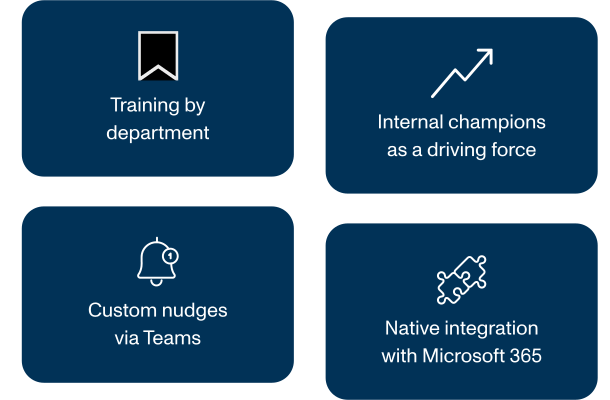
- Department-specific training: sessions calibrated by business function and level of digital proficiency, with real use cases. No generic training: each group received examples directly relevant to their daily work.
- Internal Champions as the engine: a selected group of employees acted as a driving force for the rest of the group, encouraging participation and facilitating peer-to-peer sharing from the very first week.
- Personalized nudges via Teams: Copilot Circle's AI agent monitored each user's usage levels, sending contextual notifications via Microsoft Teams with practical prompts and course suggestions calibrated to their maturity level.
- Native Microsoft 365 integration No new platform to adopt. Everything operated within the existing Microsoft environment, minimizing friction and ensuring the adoption journey required no changes to established working habits.
In the first phase, the program focused on Copilot Premium. Sessions were calibrated by department and level of digital proficiency, with real and practical use cases. To make the program effective from the outset, a group of internal Champions was brought in as the first reference nucleus: selected individuals who acted as a driving force for engagement across the wider group, encouraging participation and facilitating peer-to-peer sharing among colleagues.
Alongside the training program, a dedicated community was activated where practical tips, usage examples, and answers to user questions were shared on a regular basis. This space played a key role in keeping attention on the tool alive during the weeks between sessions, creating a sense of continuity that synchronous training alone could not have guaranteed.
Once the Copilot Premium program was complete, the initiative extended to Copilot Chat, the version included in standard Microsoft 365 licenses.
At this stage the scale increased significantly: over 7,000 employees were involved in dedicated webinars, with participation rates among the highest ever recorded by the company for initiatives of this kind. The targeted training triggered a visible shift in usage behavior, with Copilot overtaking ChatGPT as the most widely used AI tool within the organization.
The Copilot Circle platform completed the picture: the AI agent took over monitoring usage levels for each individual user, sending personalized nudges via Microsoft Teams and ensuring that the learning process didn't end when the structured program did.

The results: a pilot that became a strategic choice
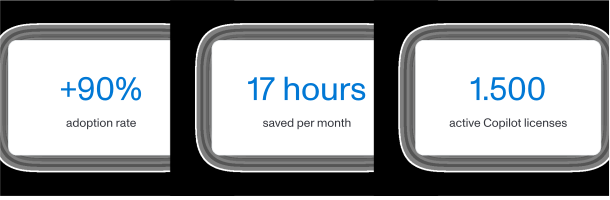
The data collected at the end of the pilot program spoke clearly. The adoption rate remained consistently above 90%.
Internal surveys recorded a high level of satisfaction both with Copilot as a tool and with the training program itself, with many participants explicitly expressing the wish for the solution to be extended to all their colleagues.
These results convinced the group's leadership to take a decisive step: from an initial group of around 300 to 400 Copilot Premium licenses, the company decided to invest in nearly 5,000 new licenses, bringing Copilot in a structured way to a significant portion of its global workforce. A clear signal that the pilot wasn't perceived as a concluded experiment, but as proof of a path worth pursuing at scale.
At that kind of scale, a continuous adoption system isn't an option: it's an operational necessity. Copilot Circle becomes the essential tool both for IT, which needs to monitor usage across thousands of people, and for HR, which needs to ensure scalable and up-to-date training over time.
Another element that emerged clearly was the value of license rotation. Thanks to the Copilot Circle dashboard, the IT team was able to identify inactive users and redistribute licenses to those more motivated to use them, maximizing the return on investment.

What's next?
With nearly 5,000 Copilot licenses now active, the group is entering its most demanding phase: ensuring that adoption consolidates at a much larger scale, involving functions and offices previously excluded from the pilot.
Copilot Circle will be the operational tool for this phase, with a specific focus on the automatic onboarding of new users, intelligent license rotation, and the identification of departments with the greatest potential for implementing AI agents in internal processes. The stated goal is to take Copilot from an individual productivity tool to an enabling infrastructure for business processes.
💡 The hardest part wasn't buying the licenses. It was making 10,000 people actually want to use them.
Are your Copilot licenses sitting unused? Book a demo and discover how Copilot Circle guarantees real, measurable, and sustained adoption over time.


.svg)
.svg)