
Many companies wait until every piece is in place before bringing generative AI to their people. This one decided to start straight away. An Italian manufacturing group, active in industrial automation and with subsidiaries on several continents, set out to test Microsoft 365 Copilot through an exploratory programme. Around eighty licences spread across different functions, and one clear goal: understanding whether and how the AI assistant could fit into people's daily work.
There was a significant obstacle, though. Most of the company's documents were still stored on local servers, out of reach for Copilot, which works on the content available in the Microsoft 365 environment. In the adoption path we usually recommend, moving data to the cloud comes before training. Here the order was reversed.
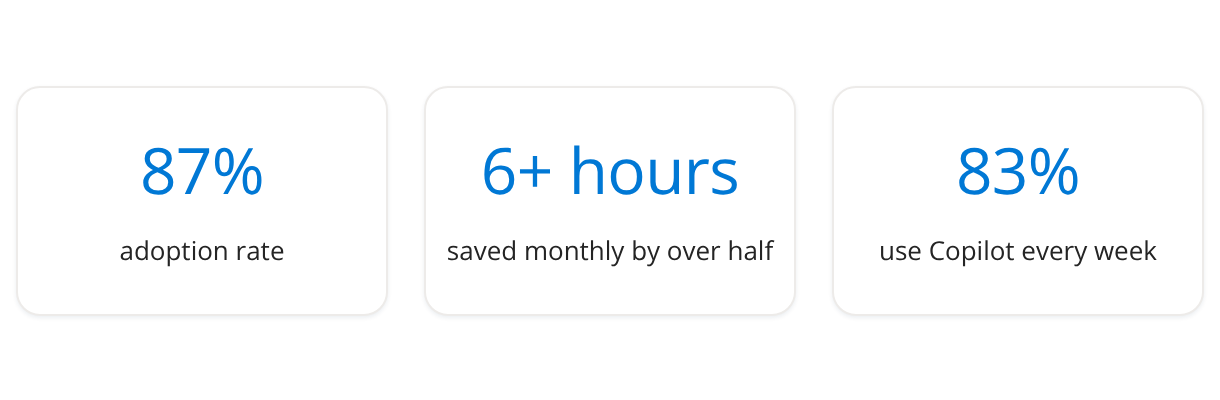
In the weeks after the summer, 87% of licensed users were actively using Copilot, and more than half of the survey respondents reported saving at least six hours a month. These results convinced the group to go one step further and choose the Copilot Circle platform to make adoption continuous, just as it was completing its move to the cloud.
The challenge: testing Copilot with data still on premises
The group wanted to understand how Copilot could fit into its daily work. The starting conditions, however, made the exploration harder than usual, with the risk of judging the tool on a partial experience.
Microsoft 365 Copilot works on the content each person can access in Microsoft 365, such as files in SharePoint and OneDrive, Outlook email, and Teams chats and meetings. With most documentation still on local servers, the use cases built around searching and summarising company documents were heavily limited. People could only try part of what the tool can do, and that part risked becoming the yardstick for the whole project.
The initial assessment also showed a cautious attitude towards AI. More than half of the participants used AI tools rarely or never, and their opinion of the solutions they had already tried was lukewarm at best. An audience starting from this point needs examples close to its own work to overcome scepticism, and a generic tour of features is unlikely to win it over.
The same survey revealed where the effort was concentrated. Nine people in ten write and reply to email every day, and over half find it tiring. More than 60% said that summarising long email threads took them a lot of time, and almost one in two found writing meeting minutes a burden. For a group with subsidiaries abroad, communication in several languages is also part of the routine, with emails to translate on a regular basis.
Finally, the training was delivered in two blocks, before and after the summer break. A few weeks away from the desk are enough to lose a newly formed habit, and an exploratory programme interrupted halfway can struggle to regain momentum.

Our solution: an adoption programme built around daily work
The group chose to start the programme before completing its migration. Even with limited access to company documents, Copilot could still support everyday tasks such as email, meetings, translations and information searches with Copilot Chat, and these became the ground on which people judged the tool for themselves.
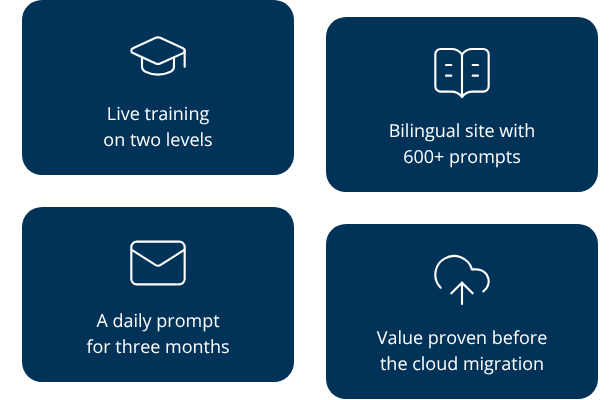
Our adoption specialists delivered a series of 14 webinars on Copilot features in the Microsoft 365 apps and on cross-cutting topics. The training ran in two blocks, with:
- basic-level sessions, before the summer
- intermediate-level sessions, in the autumn.
Alongside the webinars, participants had access to a bilingual training site that brought together more than 600 ready-to-use prompts, recordings of every session, 47 short videos and over 300 FAQs, so that anyone could catch up on a topic or go deeper exactly when they needed it.
To keep usage alive between sessions, the programme was paired with a daily newsletter offering a prompt to try straight away. This daily appointment accompanied participants for three months, with a pause during the holidays.

The results: Copilot became part of the working week
The clearest signal came after the summer. Copilot activity rose as soon as the programme started, dipped during the holidays as expected, then climbed again in the autumn. In the four weeks after the summer, 69 of the 79 licensed users were active, an adoption rate of 87%, with more than 3,000 actions completed mainly in Outlook, Copilot Chat and Teams for email coaching, information searches and meeting recaps.
Habits changed as well. Before the programme, most participants used AI rarely or never; in the final survey, 83% were using Copilot at least once a week, and more than half reported saving at least six hours a month, even without access to most company documents. Some had already moved beyond the basics, trying Microsoft agents such as Researcher and Prompt Coach or building their own, and the training itself was rated very positively, especially for the trainers' preparation.
- Adoption that survived the summer: usage recovered after the holidays and settled at 87% of licensed users, a sign that Copilot had become a habit rather than a novelty.
- Time savings with limited data: close to a full working day saved each month for more than half of the participants, achieved while most company documents were still on local servers.
- A decision based on evidence: the results of the exploratory programme gave the group the confidence to invest in continuous adoption with Copilot Circle.

What's next?
In the final survey, participants asked for training more focused on their role and on the work of their department. This is the kind of support the Copilot Circle platform delivers automatically, and the group chose it once the programme was over, just as a large share of its data was reaching the cloud. Its Adoption Agent reads the usage data Microsoft already provides, classifies each person by maturity level, and sends prompts, use cases and micro-courses in Teams or by email according to level and role, while IT and HR follow adoption from a dedicated dashboard. Only usage signals are analysed: prompts and conversation content are never read.
With a good part of its documents now in the cloud, Copilot can work on more of the files people use every day, opening up use cases that were out of reach during the first programme. Among the recommendations shared at the end of the programme is also the evaluation of dedicated agents for specific activities.
💡 The cloud migration was still under way, but the habit was already there: the best moment to start adopting Copilot is before the data is ready.
Still moving your data to the cloud and wondering whether it is too early for Copilot? Book a demo and find out how Copilot Circle helps your people build the habit today, so they are ready to make the most of it tomorrow.